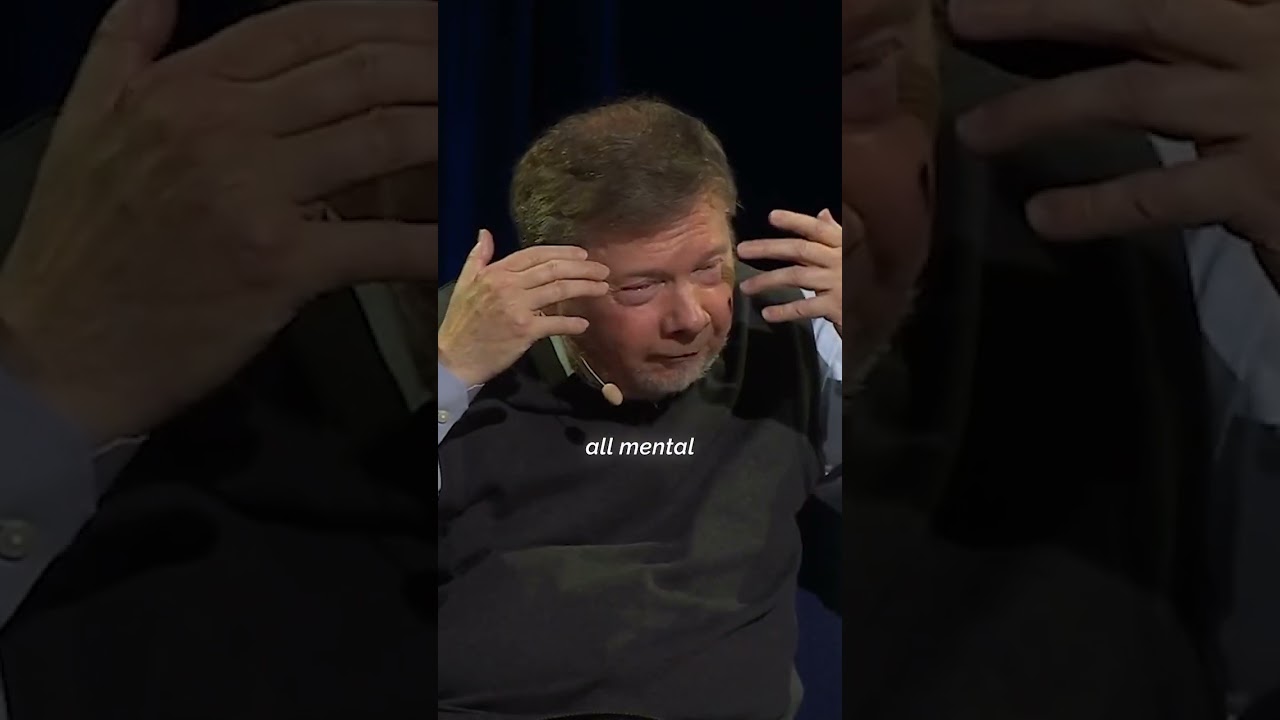
Eckhart Tolle frames death not as total annihilation but as the dissolution of physical form. The body, though it appears solid and permanent, is held together by an invisible presence—consciousness or life force. When that presence departs, the atoms that constitute the body simply return to their origin. This reframing moves death from existential terror to a natural process of form returning to formlessness, continuity shifting from the personal to the universal.
Why Does the Body Feel Permanent When It Is Not?
The fundamental misunderstanding about death begins with how we perceive the body itself. The body appears solid, dense, and lasting—something that persists in time as a unified "thing." We live inside this form, identify with it, and unconsciously assume it is the repository of our existence. Yet this solidity is an illusion created by perception itself.
According to Tolle's framing, what makes the body cohere as a unified organism is not the atoms themselves—atoms are mostly empty space—but an invisible presence that holds them together. This presence is not mystical jargon but refers to the subtle organizing intelligence, the life force or consciousness that animates matter and gives it coherence and pattern. Without this invisible presence, there is no body, only dispersed particles.
This distinction is crucial: we mistake the form for the animating principle. We identify with the body as if it were the essence of who we are, when in fact the body is a temporary arrangement of matter organized by something immaterial and invisible. The appearance of permanence comes from the continuity of that organizing presence during a lifetime—but that continuity is never assumed to be eternal.
What Is the Invisible Presence That Holds the Body Together?
Tolle does not name this presence as God, soul, or spirit in the conventional sense—he leaves the language open, suggesting it may be understood differently across traditions. The key insight is that matter alone cannot explain coherence or life. Atoms are governed by physical laws, but the organization of those atoms into a living, conscious organism requires something beyond the atoms themselves.
This invisible presence is what enables sensation, thought, movement, and awareness. It is the difference between a living body and a corpse—the same atoms arranged nearly identically, but one animated and the other inert. The presence is not separate from the body but is the essential condition for the body to function as a living system.
One way to understand this is through the concept of presence itself—a term Tolle uses throughout his teaching to refer to conscious awareness in the present moment. When you are fully present, there is an aliveness to your experience. When you are lost in thought or ego, that aliveness diminishes. The "invisible presence" that holds the body together may be understood as presence itself—the fundamental aliveness of consciousness expressing through form.
What Happens to Matter When Death Occurs?
Death, in this view, is the moment when that organizing presence departs. The atoms do not vanish; they do not cease to exist. Instead, they disperse. They return to the environment—to the earth, the air, the water, the food chain. The carbon in your bones becomes part of soil. The hydrogen in your cells becomes part of the water cycle. The calcium, phosphorus, nitrogen—all return to circulation in nature.
This is not metaphorical. It is literal atomic recycling. The atoms that composed your body at death will become part of other organisms, other bodies, other forms. In this sense, there is no loss of matter, only a loss of form. The atoms that were organized as "you" become disorganized, their pattern dissolved, their individual coherence ended.
This process happens not instantaneously but over time. Decomposition is the gradual dissolution of form. Cremation accelerates it. But the endpoint is the same: the form returns to the formless, the organized returns to the unorganized, the individual arrangement returns to the universal pool of matter.
Is Death the End of Existence or a Transformation?
Here Tolle's teaching introduces a subtle but profound distinction. From the perspective of form and individuality, death is indeed the end. The particular body ceases to exist as a coherent whole. The personality, the memories, the identity tied to that body—all end with it (or at least cease to function in the way they did). In that sense, what we call "I" does not continue in the form it took during life.
But from the perspective of matter and consciousness as universal principles, nothing is lost. Matter is eternal—it cannot be created or destroyed, only transformed. And consciousness, in Tolle's teaching, is not a product of the individual brain but a fundamental dimension of reality that expresses itself through form. When the form dies, consciousness does not die; it simply no longer expresses through that particular form.
This is not the same as conventional notions of an eternal soul or afterlife, where the individual personality persists in some realm. Rather, it suggests that what you essentially are—presence, awareness, being itself—is not created by the body and therefore cannot be destroyed by its dissolution. But the continuity of personal identity, of "you," does end.
Why Does This Matter for How We Live Now?
Understanding death as the dissolution of form rather than annihilation shifts the psychological and spiritual relationship to mortality. If death is total obliteration and non-existence, it provokes existential anxiety and the ego's desperate attempts to deny or escape it. This denial often manifests as compulsive striving, attachment to possessions, or attempts to achieve immortality through legacy or achievement.
If death is understood as the return of atoms to their source and the release of individual form back into the universal substrate, it becomes less threatening. There is a natural closure to it. The atoms were borrowed from the earth; they return to the earth. The consciousness that animates form is not your personal possession to keep forever; it flows through you for a time and then flows elsewhere.
This reframing can reduce the unconscious fear that subtly governs many people's choices. When you cease to fight death or deny its inevitability, you paradoxically become more alive. You stop being driven by the need to "make your mark" or "beat the clock." You become present to what is actually here, now, rather than anxiously securing a future that may never arrive.
Additionally, this understanding invites humility about the separateness of the self. Your body is made of matter that comes from the earth and will return to it. You are not as separate from nature as the ego suggests. This dissolution of the illusion of absolute separateness can open compassion and a sense of kinship with all living things.
Where to Go From Here
Tolle's teaching on death is not meant to be abstract philosophy but a practical pointer to how to live. If you recognize that your body is held together by an invisible presence—by consciousness itself—you might begin to notice that presence now, in this moment. Meditation practice, particularly awareness of the breath or the sensation of presence in the hands, can make this invisible animating force more tangible.
Reflect on the atoms in your body and where they came from. The carbon in your cells was forged in stars. The water in your body has cycled through countless organisms and the earth itself. You are already participating in the great recycling of matter. Death is simply the completion of that cycle for the form you currently inhabit.
Finally, notice how the fear of death may be operating in your life right now—in the urgency you feel, the things you cling to, the ways you try to prove yourself. What would change if you accepted that your form is temporary and your deepest nature is the presence that animates form? That shift in understanding is not morbid but liberating, freeing energy for presence, connection, and genuine living.