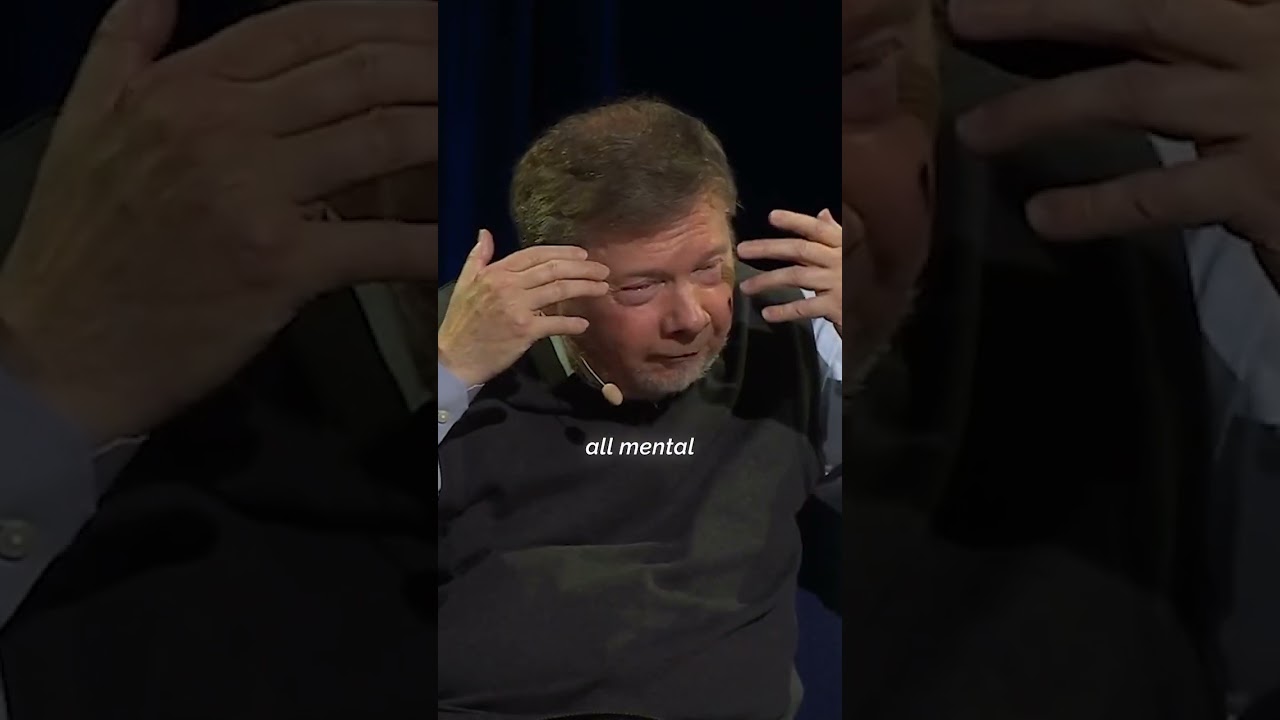
Eckhart Tolle explores the profound freedom available when you step outside the constant stream of thoughts and experience life as it actually is—unmediated by conditioning. Rather than trying to control or change thoughts, this teaching invites you to practice pure perception and cultivate alert stillness, where awareness becomes aware of itself. Through simple practices rooted in presence, you can access the relief and joy that arise when you transcend the personality and embody your essence identity as formless Being, recovering the childlike wonder and fresh aliveness you once knew naturally.
What does it mean to step outside thinking?
In conventional life, most people experience the world filtered through an almost unbroken commentary of thought. The mind constantly narrates, judges, compares, and projects—a process so automatic that most people mistake this stream of thinking for reality itself. Eckhart Tolle's core invitation is to recognize that there is a mode of perceiving and existing that does not require this continuous mental overlay.
When you step outside thinking, you don't stop your mind from functioning when necessary. Rather, you discover the capacity to perceive and be present without immediately wrapping that perception in a layer of conceptual interpretation. A bird's song is heard as pure sound before the mind labels it "beautiful" or "annoying." A meal is tasted directly before thoughts about nutrition or calories arise. This is not a rejection of thinking—it's a recovery of the ability to experience life before thought intervenes.
This freedom is radical because it directly challenges how most people have learned to navigate the world. We are taught that safety, success, and understanding come through thinking—through planning, analyzing, and controlling. The teaching suggests something different: that a more fundamental aliveness, peace, and clarity are available when you rest in awareness itself, prior to thought.
How does pure perception differ from thought-filtered experience?
Pure perception is the direct contact with what is, unmediated by the interpretive machinery of the conditioned mind. When you engage in pure perception, you are receiving information through your senses without the immediate addition of story, significance, or judgment. Colors are vivid. Textures are felt. Sounds arrive as vibrations before they are categorized. This freshness—what Tolle invokes as a "childlike wonder"—is available in every moment, but it becomes obscured when the mind's narrative layer becomes the default mode.
In thought-filtered experience, what you encounter is not the thing itself but your mental representation of it, loaded with associations, memories, and conditioning. You see a person and immediately activate the story you've constructed about who they are. You enter a space and immediately evaluate whether it meets your preferences. You experience a feeling and your mind immediately explains why you shouldn't feel that way. The world becomes a text to be read and decoded rather than a presence to be met.
Pure perception invites a different relationship. You can still think and remember when it serves a practical purpose—reading a map, recalling where you left your keys—but you are not identified with thought as your primary mode of reality contact. This shifts consciousness from the perspective of the thinker (separate, analyzing, managing) to the perspective of aware presence itself, which is already in intimate contact with what is.
What is alert stillness, and how do you cultivate it?
Alert stillness is a paradoxical state in which awareness is awake, attentive, and responsive—yet not restless, not seeking, not driven by the agitation of mind. It's like the stillness of a cat before it pounces: completely present, energetically available, yet perfectly calm. In this state, as Tolle describes it, awareness becomes aware of itself. You are not aware of something (an object, a thought, a feeling). Rather, awareness turns inward and recognizes its own nature.
Cultivating alert stillness begins with the simple practice of returning attention to the present moment—not as a mental exercise, but as a release of attention from the narrative dimension of mind into the direct dimension of sensation and presence. You might notice your body in the space you occupy. You might listen to ambient sounds without naming them. You might feel the texture of an object you're holding. These are not distractions from "real" meditation; they are the direct doorway into present awareness.
The key is that this state is not effort-driven in the ordinary sense. You don't "try hard" to be still in an alert way; rather, you allow the over-activity of thinking to settle, the way sediment settles when you stop shaking a jar of water. As the mental noise quiets, what remains is not blankness or unconsciousness but rather a heightened, crystal-clear awareness. Your senses sharpen. Subtle details become apparent. A sense of ease and rightness pervades the experience because you are no longer fighting reality or trying to make it conform to a pre-existing mental template.
How does "Let It Be" wisdom relate to freedom from conditioning?
The phrase "Let It Be"—borrowed from the Beatles song but rooted in spiritual traditions spanning centuries—encodes a specific stance toward your inner experience. Rather than the conditioned reflex of trying to change, fix, suppress, or achieve your way through life, "Let It Be" invites you to allow things to be as they are, while remaining aware. This is not passivity or resignation; it's a shift in the locus of control from the ego-mind to the deeper intelligence of Being itself.
Conditioning trains you to believe that your wellbeing depends on your constant vigilance and effort: controlling your thoughts, managing your emotions, achieving your goals, maintaining your image. This hypervigilance creates a low-level chronic tension. You are always partly dissatisfied with what is, always partially oriented toward what should be instead. In this state, you cannot fully inhabit the present moment because part of your awareness is always in an imagined future or a regretted past.
"Let It Be" invites the courage to stop the struggle and discover what naturally arises when the struggle quiets. A thought arises—let it be, without resistance or identification. An emotion moves through the body—let it be, witnessing it with curiosity rather than judgment. The sun sets, the breath moves, birds sing—let these be, without the constant need to have an opinion about them or improve them. In this allowing, a radical relief emerges: the burden of maintaining a separate self, constantly managing reality, begins to lift.
This is how "Let It Be" wisdom dissolves conditioning. Conditioning is the accumulated patterns of contraction, control, and resistance. Each time you practice the opposite—allowing, accepting, witnessing without judgment—you're loosening the grip of those patterns. Over time, a new default emerges where you can think when thinking serves, but you are not imprisoned in thought. You can take action when action is needed, but you are not compulsively driven. You inhabit your life rather than constantly judging and trying to fix it.
What is essence identity, and how does it relate to the personality?
The personality, in Tolle's framework, is the accumulated psychological structure built from early conditioning, trauma, survival strategies, and learned patterns of thought and behavior. It's the "self" you present to the world and the self you experience as the narrator of your inner life. The personality operates primarily through thought—through the mental commentary that says "I am like this," "I need that," "I am threatened by that." It is inherently separate, bounded, and defended because it must maintain itself against a world it perceives as other and potentially hostile.
Essence identity is something radically different. It is your fundamental nature prior to conditioning—what Tolle calls your "formless Being." It has no story, no boundaries, no need to prove itself or defend itself. It is not constructed; it is discovered. This essence is what a child embodies before heavy conditioning accumulates: a natural presence, openness, and aliveness that doesn't require achievement or performance to validate.
The teaching suggests that the joy and relief that arise when you transcend the personality are not temporary highs but glimpses of what you actually are beneath the layers of acquired conditioning. When the personality relaxes its grip—even for a moment—you feel what Tolle describes as relief, spaciousness, and a kind of natural joy that doesn't depend on external circumstances. This is not an exotic state reserved for advanced practitioners; it is the baseline of consciousness when it is not distorted by excessive identification with thought and personality.
As you cultivate alert stillness and pure perception, you are gradually learning to identify less with the personality and more with the essence. This doesn't mean the personality disappears or becomes dysfunctional in the world. It means the personality becomes a tool you use when needed, rather than the totality of who you are. You can still navigate, plan, and interact—but from a deeper ground of being that is untouched by the personality's stories of lack, fear, and separation.
How do you practice rediscovering childlike wonder in daily life?
A child perceives the world with what Tolle describes as freshness and wonder not because the child has some special ability but because conditioning has not yet heavily overlaid the direct perception. A child can be absorbed for minutes in watching water flow or leaves move. The world is inherently fascinating because it hasn't been flattened by familiarity and judgment. To rediscover this quality doesn't mean regressing to immaturity; it means recovering the freshness of perception while retaining adult capability.
In practical terms, this involves interrupting the automaticity of thought and deliberately reopening direct sensory contact with your environment. Stop and really look at something ordinary—a plant, a wall, the sky—without immediately generating thoughts about it. Listen to sounds around you as pure vibration before naming them. Feel the temperature and texture of things your hands touch. Take a single bite of food and taste it with full attention before your mind supplies the narrative: "good," "healthy," "expensive," etc.
These are not exercises meant to generate special experiences. Rather, they are invitations to notice what is already here when the mind's constant commentary pauses. You will likely find that presence itself is inherently interesting. Reality, when met directly, is far richer and more alive than the flattened version your habitual thoughts have constructed. A walk becomes not just a way to exercise the body but a continuous discovery. Conversation becomes not just an exchange of information but a meeting of presence. Even mundane tasks—washing dishes, sitting in traffic—become portals to this direct aliveness when your attention shifts from the mental narrative to the present moment.
What makes this sustainable is that childlike wonder is not something you're trying to force or manufacture. You're simply removing the obstacles—the layers of judgment, analysis, and expectation—that were blocking the natural wonder that is always latent in direct perception.
Where to go from here
The teachings in this video invite a fundamental shift: from operating primarily through thought and conditioning to learning to rest in alert awareness and pure perception. This is not a someday-in-the-future project but something available right now, in your next breath, in your immediate sensory environment. You can pause this reading, close your eyes, and notice the quality of awareness itself. You can look around and practice seeing without immediately thinking about what you're seeing. You can release one area of your life where you are habitually trying to control or fix things, and practice allowing it to be as it is while remaining attentive. Each of these is a doorway into the freedom Tolle describes. As these practices accumulate, they build a new relationship with thought and mind, and gradually the default shifts from living imprisoned in the personality and its endless mental commentary to living from your essence—fresh, alive, at ease, and free.