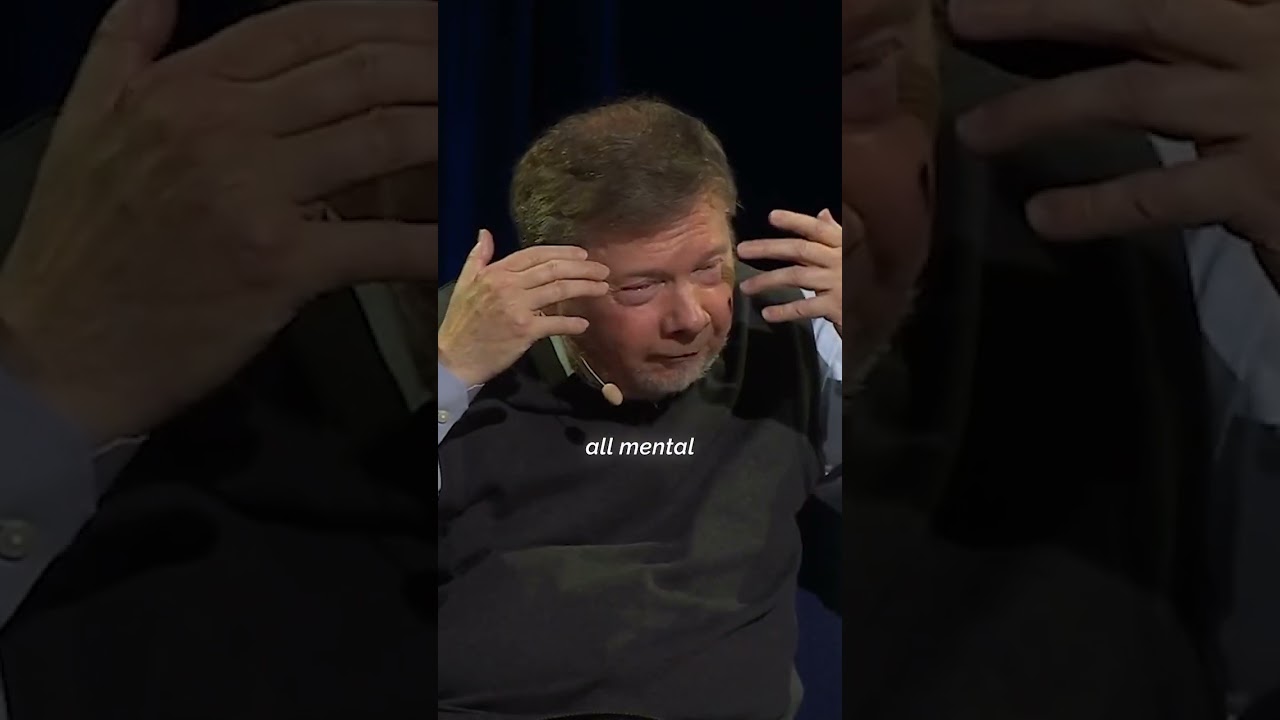
Rather than eliminating life's challenges, Eckhart Tolle teaches that evolving your approach through conscious awareness fundamentally transforms how you relate to difficulty. By shifting from a reactive, mind-dominated response to difficulty toward a presence-based awareness, you access a new dimension of freedom where challenges no longer dominate your inner state. This is not about positive thinking or denial of problems, but about changing the dynamics at the root level—the relationship between your consciousness and what you face.
Why Our Default Response to Challenge Keeps Us Trapped
Most people approach life's difficulties the same way: they identify with the problem, mentally spin around it, and believe the challenge itself is what causes suffering. This assumption runs deep. When faced with an obstacle—illness, loss, failure, conflict—the mind immediately works to solve, escape, or reject it. The energy goes into resistance. But this resistance itself becomes the primary source of suffering, often more than the external situation.
Tolle's insight is that the challenge is not the problem; the dynamics of how we meet the challenge is. When you are entirely absorbed in the mind's interpretation of difficulty—its stories about what it means, how unfair it is, what it will lead to—you are operating from contraction, fear, and separation from the present moment. In this state, the challenge owns your consciousness. You are not free; you are consumed by it.
How Does Awareness Change the Nature of a Challenge?
Awareness, in Tolle's teaching, is not thought about a problem. It is presence. It is the conscious space in which the problem appears. When you bring awareness to a difficulty without immediately fleeing into thinking, something shifts. The challenge is still there—that is not the point. But you are no longer merged with it. You have created space between your consciousness and the content of your experience.
This space is critical. In it, you are no longer entirely defined by the problem. Your identity does not collapse into the difficulty. You can think clearly about it, respond intelligently to it, even feel what arises in your body—but you are not lost in it. This is the new dimension of freedom Tolle points to: not freedom from challenges (which is impossible), but freedom in the midst of them.
The shift from reactive unconsciousness to conscious presence changes the dynamics. Instead of the challenge feeding your sense of lack, fear, or unworthiness, it becomes something you encounter from a place of relative wholeness. Your well-being is no longer dependent on the challenge disappearing. This does not mean you become passive; in fact, action flows more intelligently from a state of presence than from panic.
What Does It Mean to Evolve Your Approach?
Evolving your approach is not about developing a better mental strategy or a more positive mindset. It is about a fundamental shift in where you are coming from when you face difficulty. Most people's approaches remain stuck at the level of thought and reaction. Evolving means moving to the level of consciousness itself—to presence, to what Tolle calls awareness.
This evolution has concrete effects. When you are present to a challenge rather than consumed by your mental narrative about it, your nervous system settles. You access wisdom that is not available when you are in a state of contraction. Your creativity, resilience, and clarity all increase. Problems that seemed insurmountable from the mind's limited perspective often reveal unexpected solutions when approached from presence.
The paradox is that this is not about becoming stronger in the ego sense—more willful, more determined to overcome. It is about becoming more spacious, more allowing, more aligned with what is actually present rather than what the mind fears or demands. From this place, you naturally respond better.
Why Doesn't Awareness Eliminate the Challenge Itself?
Challenges are part of existence. They are not errors to be corrected. Physical limitation, change, loss, and difficulty are woven into the human condition. Tolle does not promise that awareness removes these realities. What awareness does is remove your entanglement with them—the suffering layer that the mind adds on top of circumstances.
Consider pain, which may arise in the body. The physical sensation is one thing. The mind's resistance to it, its judgment that it should not be happening, its spinning about what it means—this is where the secondary suffering is born. Awareness does not make pain disappear, but it allows you to relate to it fundamentally differently. The suffering decreases even if the sensation remains.
This is why evolving your approach is more powerful than solving the problem. Some challenges cannot be solved—you cannot undo loss, you cannot always change external circumstances. But you can always change your relationship to them. This is the only freedom that is always available.
What Is This New Dimension of Freedom?
Freedom, in Tolle's vision, is not the absence of difficulty. It is the quality of consciousness you bring to difficulty. It is the difference between being locked in fear and reaction versus being alert and responsive. It is the difference between your sense of self depending entirely on outcomes versus being rooted in presence itself.
When you taste this freedom—even briefly, when you realize that your awareness is not the same as your thoughts, that you can observe a challenge without being consumed by it—something irreversible shifts. You realize that a large part of what you believed was forced upon you was actually your own contracted response to it. This recognition itself is liberating.
This freedom is not something you achieve and then possess forever. It is not a permanent state where challenges no longer arise. Rather, it is a dimension available to you, a way of being that you can return to again and again, becoming more familiar with it over time. Each time you meet a difficulty from presence rather than from thought alone, you reinforce this capacity.
How Do You Actually Access This Shift in Practice?
The shift begins with noticing. When you are in the midst of a challenge, can you become aware that you are thinking about it? Can you feel the sensation in your body that accompanies the worry or resistance? This awareness itself—this stepping back from complete identification with thought—is the beginning. You do not have to do anything with what you notice. Simply the noticing creates space.
Breath is often a doorway. When you bring attention to your breath in the midst of difficulty, you anchor yourself in the present moment and the body, which pulls you out of the mind's narrative. A few conscious breaths can reset your state. This is not breathing to relax in order to think better about the problem; it is breathing to come present, which naturally shifts the dynamics.
Over time, as you practice meeting situations from awareness rather than reactivity, you build a new capacity. The mind still arises with its interpretations and fears—that is its nature. But increasingly, you are not entirely trapped in that voice. You have a larger context, a witness, a space of presence from which you can observe it.
Where to Go From Here
If this principle resonates with you, the invitation is to experiment with it in your own life. Begin with small challenges—mild frustration, minor discomfort—and notice what happens when you pause and bring conscious awareness to them rather than immediately engaging your habitual reaction. Feel the difference between being lost in thought about the difficulty and being aware of the difficulty while you think.
Understand that this is not about denying problems or adopting false positivity. It is about discovering a freedom that exists beneath and alongside your difficulties, a freedom that no external circumstance can take from you because it is based not on what happens to you but on how conscious you are. This shift—from change the circumstance to change the dynamics—is what opens new possibilities.