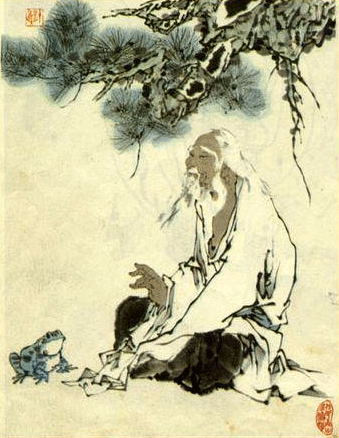
The Surrender of the Universe to Stillness
Chuang Tzu's assertion, "To a mind that is still, the whole universe surrenders," invites us to consider the profound relationship between our inner state and the external world. In essence, he suggests that when our minds are calm and undisturbed, we can perceive the universe in its entirety, as if it yields its mysteries to us. This notion is not merely poetic; it speaks to the heart of our spiritual journey, emphasizing the importance of cultivating stillness in a world rife with chaos and distraction.
In a time when our lives are often dictated by noise—both external and internal—this quote serves as a gentle reminder of the power of tranquility. The still mind is not passive; rather, it is a fertile ground for insight and understanding. When we quiet our thoughts, we create space for the universe to reveal itself, allowing us to connect with the deeper currents of existence. This surrender is not about control but about harmony, suggesting that true wisdom arises when we align ourselves with the natural flow of life.
The image / the metaphor
The imagery in Chuang Tzu's words evokes a sense of surrender and openness. The phrase "the whole universe surrenders" suggests a vastness that is willing to yield its secrets to those who approach it with a still mind. The verbs chosen—"to surrender"—imply a gentle yielding rather than a forceful conquest. This paints a picture of a relationship between the seeker and the cosmos, one that is based on receptivity rather than aggression. In this stillness, the universe is not an adversary to be conquered but a partner in discovery.
Diving deeper into the metaphor, we can see that stillness is not merely the absence of noise or distraction; it is an active state of being that allows for clarity and insight. In this context, the mind becomes a lens through which the complexities of existence can be understood. When we cultivate stillness, we are not just quieting our thoughts; we are opening ourselves to the profound interconnectedness of all things. The universe, in its vastness, is ready to share its wisdom, but only with those who are prepared to listen.
In the speaker's tradition
Chuang Tzu's teachings are deeply rooted in the Taoist tradition, which emphasizes harmony with the Tao, or the fundamental nature of the universe. Concepts such as wu wei, or effortless action, resonate with the idea that stillness allows for a more profound engagement with life. In Taoism, the mind's stillness is seen as a pathway to understanding the natural order of things, where one can experience the flow of existence without resistance. This aligns with the notion of sunyata, or emptiness, in Buddhist thought, which suggests that a quiet mind can perceive the true nature of reality.
In the text of the Zhuangzi, we find numerous anecdotes illustrating the value of stillness and the wisdom that arises from it. For instance, the story of the "Butterfly Dream" reflects the fluidity of reality and the importance of transcending the dualities of existence. Just as the butterfly flits between dreams and reality, a still mind allows us to navigate the complexities of life with grace and insight. This interplay between stillness and understanding is a recurring theme in Chuang Tzu's work, inviting us to embrace the paradox of existence.
Living the teaching
Consider a modern scenario where the chaos of daily life overwhelms us—perhaps during a hectic workday filled with deadlines and distractions. In such moments, the practice of stillness can feel elusive. However, if we take a few moments to breathe deeply and center ourselves, we can create a mental space that allows us to approach our tasks with clarity. This practice of pausing, even briefly, can transform our experience, enabling us to engage with our work more effectively and with a sense of calm that permeates our actions.
In relationships, the teaching of stillness can also be profoundly impactful. During conflicts or misunderstandings, our minds often race with thoughts and emotions, clouding our ability to listen and empathize. By cultivating a still mind, we can approach these moments with greater compassion and understanding. Instead of reacting impulsively, we can create a space for dialogue, allowing the universe of our shared experience to unfold. In this way, stillness becomes a bridge that connects us to others, fostering deeper connections and mutual understanding.
A reflection
As we contemplate Chuang Tzu's profound insight, we are invited to reflect on our own relationship with stillness. How often do we allow ourselves the gift of a quiet mind, free from the incessant chatter of thoughts and distractions? In what ways can we cultivate this stillness in our lives, and how might it transform our perception of the universe around us? Consider these questions as you navigate your own journey, allowing the wisdom of stillness to guide you toward a deeper understanding of yourself and the world.



Join the BrightStar Community
Stay connected with daily inspiration, event announcements, and community wisdom