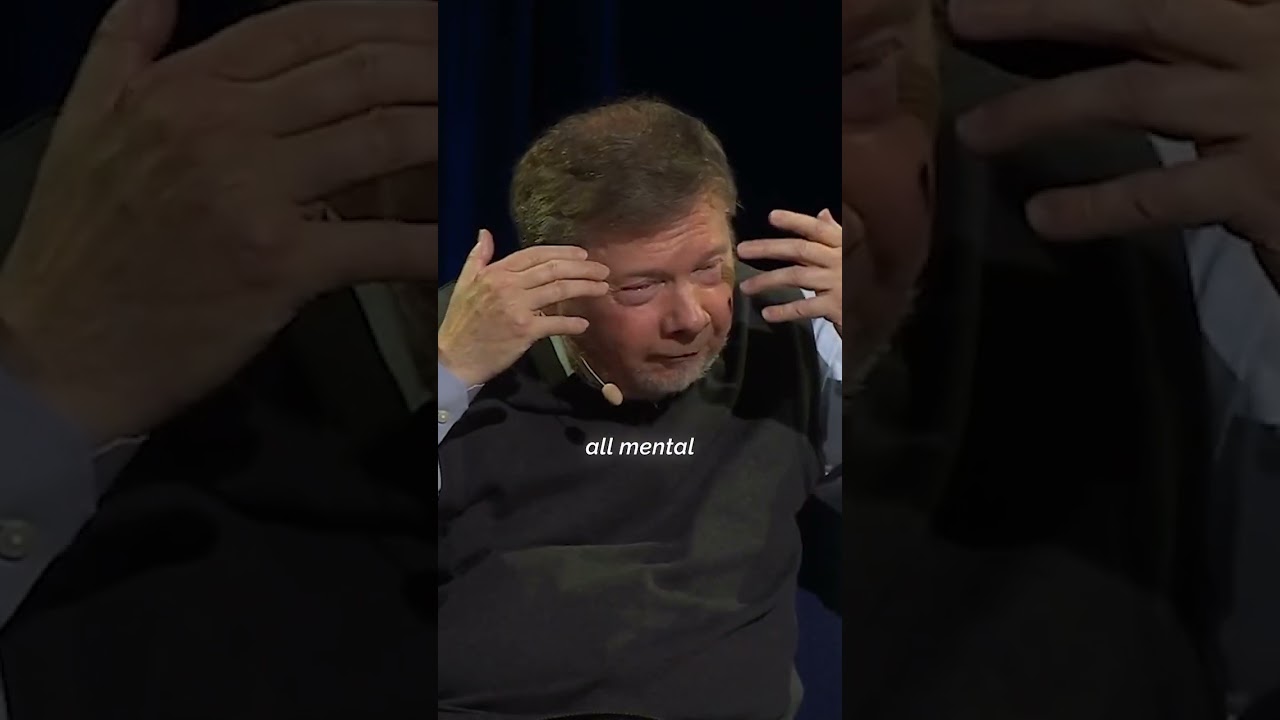
Eckhart Tolle guides viewers toward self-discovery by asking "Who am I right now?"—a question that opens a gateway beyond the constructed self of thoughts and emotions. In Part 2 of this three-part series on awakening through life's challenges, Tolle contrasts human identity (the egoic self formed from narrative and conditioning) with essence identity (consciousness itself), showing that genuine presence and spiritual growth emerge when we distinguish between external reality and the internal perceptions we layer onto it. The path forward requires recognizing that consciousness contains both thoughts and emotions, yet is not limited to them.
What Is the Difference Between Human Identity and Essence Identity?
At the heart of Tolle's teaching lies a fundamental distinction that reshapes how we understand ourselves. Human identity is constructed—it is the accumulation of beliefs, memories, narratives, and social conditioning that form what we call the ego or the "self." This identity depends on constant reinforcement. It is built from stories about who we are, what happened to us, and what we need to become. It requires enemies, enemies who validate its existence by opposing it.
Essence identity, by contrast, is not constructed. It is consciousness itself—the fundamental awareness that witnesses all experience without needing to maintain a story about itself. Essence does not depend on past identity or future achievement. It is present, available, and untouched by the fluctuations of thought and emotion. When Tolle invites the viewer to ask "Who am I right now?" he is pointing directly toward this essence, inviting an immediate recognition of awareness itself.
The gap between these two identities is where suffering and freedom intersect. Most people live primarily from constructed human identity, constantly seeking validation, protection, and enhancement of the self-story. This identity is inherently reactive and defensive. Essence identity, by contrast, is responsive rather than reactive—it can engage with life without needing to defend itself or prove itself.
How Does Consciousness Contain Thoughts and Emotions Without Being Limited by Them?
Tolle emphasizes a subtle but crucial point: consciousness is the container that holds both thoughts and emotions, yet it is not identical to either. This is a practical distinction with immediate relevance to anyone seeking to understand their own mind. Thoughts arise in consciousness like clouds in the sky. Emotions flow through consciousness like weather systems. But consciousness itself—the aware space in which they appear—remains unchanged.
This distinction matters because most people confuse their thoughts with reality and their emotions with truth. A thought arises: "I am not good enough." The person then identifies with this thought as if it were a statement of fact rather than a mental event. An emotion arises: anxiety or sadness. The person then makes decisions and conclusions based on this emotional state, treating it as information about the world rather than as a condition moving through the body and mind.
When you recognize consciousness as the container, you gain freedom. You can observe a thought without fusing with it. You can feel an emotion without acting it out. This does not mean suppressing thoughts or emotions—it means ceasing to be controlled by them. Consciousness provides the spacious awareness in which both mental and emotional events can be seen clearly, often revealing their impermanent and reactive nature.
What Is the Relationship Between Present Awareness and Self-Discovery?
Present awareness is the gateway to essence identity. Most human suffering arises from identification with past identity (regret, shame, stored grievances) or future identity (anxiety about what might happen, striving to become someone). The present moment, by contrast, is always fresh. It does not carry the burden of the past self or the constructed future self. It is only in the present that you can directly access consciousness itself.
When Tolle asks "Who am I right now?" he is not asking for a new story or a revised self-concept. He is inviting a shift in attention from the content of mind (thoughts, memories, interpretations) to consciousness itself. Right now, before any answer is formulated, there is awareness. There is perceiving, sensing, knowing. This is not a vague spiritual idea—it is something you can verify directly through immediate experience.
Present awareness also allows you to distinguish between what is actually happening and the narrative you are adding to what is happening. You may be in a difficult situation, but the situation itself is neutral. The suffering comes from the story: "This proves I am a failure," or "This should not be happening," or "I cannot handle this." Present awareness allows you to perceive the situation clearly without immediately overlaying it with judgment and meaning-making.
How Do You Distinguish Between External Reality and Internal Perception?
External reality consists of what is actually happening: sensations, events, other people's actions, circumstances. Internal perception is the mental and emotional layer we add—our interpretations, judgments, meanings, fears, and desires. Confusion between these two is the source of much unnecessary suffering.
For example, someone makes a critical comment. The external reality is the sound vibrations and the words spoken. Internal perception includes: "They don't like me," or "I have failed," or "I must defend myself." The critical comment is external reality. Your reaction to it, the meaning you assign it, the emotions it triggers—these are internal perception. Neither is inherently good or bad, but confusing them leads to reactivity.
Present awareness creates the space to observe this distinction. When you are fully present, you receive what is actually happening without immediately filtering it through your expectations and fears. You see the person's action without jumping to conclusions about their intent. You notice your emotional response arising without taking it as absolute truth about the situation. This does not mean becoming passive or accepting harm—it means responding to what is actually true rather than to your fears about what might be true.
Tolle's teaching here aligns with a practical principle: the situations we encounter are often far simpler and far less personally threatening than the stories we construct about them. A person who is present and observant sees more clearly because they are not trapped in defensive interpretation.
What Role Do Life's Challenges Play in Awakening?
The subtitle of this teaching—"Awakening Through Life's Challenges"—is significant. Challenges crack open the usual patterns of identification with the constructed self. When life becomes difficult enough, the old strategies of ego maintenance often fail. The false self cannot protect you from real pain. This is precisely the opening for awakening.
In a challenge, the familiar identity is threatened or shattered. This creates a gap, a space of vulnerability. In that space, many people have access to a deeper consciousness that was always present but hidden beneath the noise of self-maintenance. Suffering can become a teacher, pointing directly toward the fact that your true essence is not dependent on circumstances, success, or the approval of others.
This does not mean that challenges are good or that you should seek them out. Rather, when they arrive—and they inevitably do—they can be recognized as potential gateways to awakening. The question becomes: can I meet this difficulty present, without immediately identifying with a victim story or a shame story? Can I allow this to crack the shell of my constructed identity and show me what remains when the familiar self is disrupted?
Where to Go From Here
Tolle's invitation to ask "Who am I right now?" is not a philosophical puzzle to be solved intellectually. It is a practical tool for turning attention inward and verifying directly what consciousness is. You might pause and genuinely ask yourself this question—not to come up with a new answer, but to notice the awareness in which the question arises.
From here, the work is one of increasingly recognizing the difference between the constructed identity (which will continue to operate in the world, appropriately) and the essence that witnesses it all. This recognition does not happen once and then remain permanent. It is a practice of returning again and again to present awareness, to the space before thought, to the consciousness in which all content arises and dissolves.
The teachings in this series are cumulative. Part 1 laid groundwork for understanding presence and awakening. Part 2 distinguishes the levels of self and consciousness. Part 3 will presumably deepen this understanding further. The invitation is not to understand these ideas conceptually but to live them, to embody the distinction between identity and essence through direct experience in daily life.