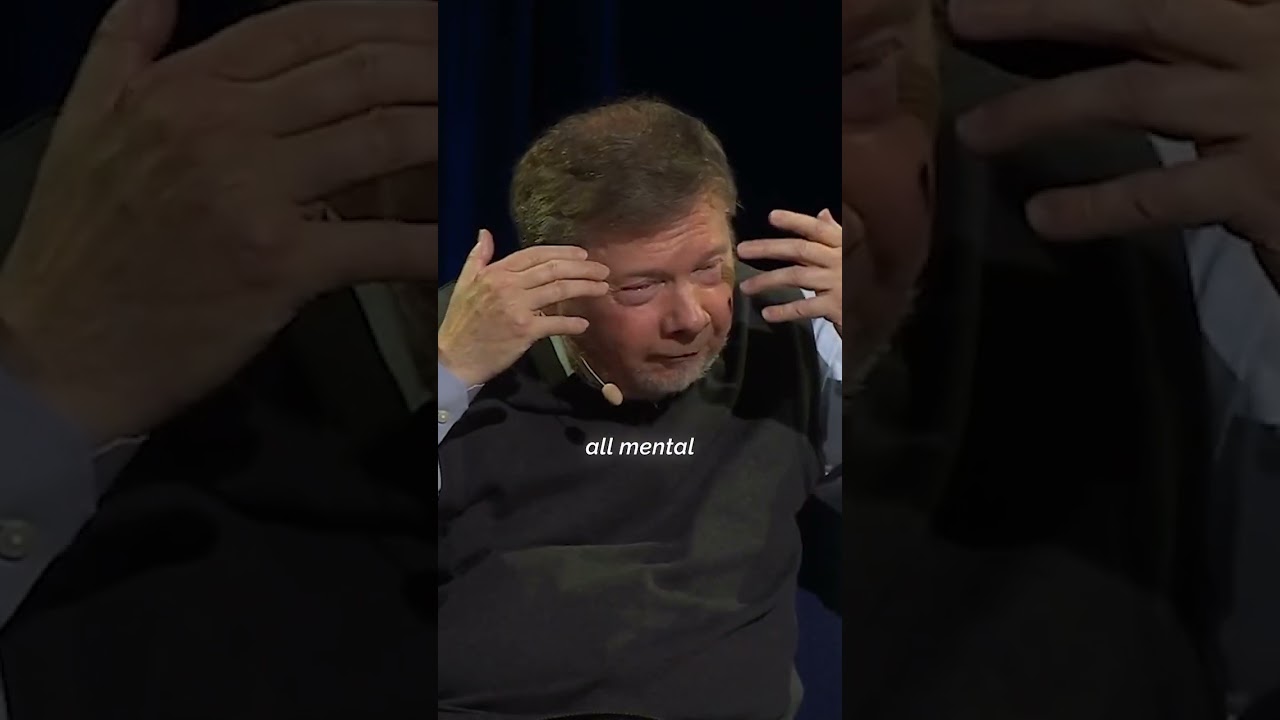
The ego does not seek fulfillment—it seeks the opposite of fulfillment, packaged as the promise of future completion. Eckhart Tolle explores a fundamental mechanism of the egoic mind: its compulsive need to identify enemies, obstacles, and opposition as a way to maintain a sense of identity and purpose. This teaching reveals why so many people remain trapped in conflict, why achievement never quite satisfies, and why the only real fulfillment available to human consciousness is found in the present moment, where no enemy can ever truly exist.
How the Ego Manufactures Enemies
The ego cannot exist in peace. It requires an adversary—real or imagined—to sustain its sense of self. When you identify strongly with your thoughts, your story, and your position in life, you automatically create a conceptual "other" against which you define yourself. This is not a character flaw; it is the mechanics of egoic consciousness.
The enemy might be another person, a rival, an institution, a disease, a circumstance, or even an abstract concept like "society" or "the system." The content of the enemy is almost irrelevant. What matters is that the ego, through opposition, generates a feeling of aliveness, purpose, and direction. When you are fighting against something, you experience intensity; you feel like you are *doing* something; you feel like your life *means* something.
This is why people often unconsciously create or perpetuate conflict in their relationships, their work, and their internal dialogue. The conflict provides structure and identity. Without an enemy, the ego faces an emptiness it cannot tolerate—not the peaceful emptiness of true being, but the void of meaninglessness that arises when egoic momentum stops.
Why Achievement Never Fully Satisfies
The ego promises fulfillment through achievement, through winning, through "getting there." Yet every achievement, no matter how significant, eventually loses its power to satisfy. The goal is reached, the trophy is won, the promotion arrives—and within days or weeks, the sense of completion fades. Why? Because fulfillment was never actually tied to the achievement. The achievement was only ever a vehicle for a temporary intensity, a temporary sense of purpose created by the struggle itself.
Once the enemy is defeated or the goal is reached, the ego must immediately generate a new enemy, a new goal, a new future to reach for. This is the treadmill of perpetual incompleteness. The ego is addicted to the *process* of striving, not to the actual arrival at any destination. It promises that completion lies in the future—in the next achievement, the next relationship, the next possession, the next milestone. But the future never comes. What comes is always the present moment, and the ego, by definition, cannot operate in the present because it is a time-based construct.
The Fundamental Dysfunction: Time as the Ego's Currency
The ego lives in time. It has a past (the story of who you are, shaped by memory and interpretation) and a future (the story of who you will become, the destination you must reach). It cannot exist in the now. When awareness is fully present, the egoic structure temporarily dissolves because there is no time to sustain it—no past to defend, no future to reach for.
This is why meditation and presence-based practices feel so foreign, even threatening, to people deeply identified with the egoic mind. The present moment, in its wholeness and completeness, offers no platform for the ego's narrative of lack and striving. In the present, you are already complete. Nothing is missing. The body breathes, the heart beats, awareness is here—and none of this requires an enemy or a future goal to validate it.
The ego cannot tolerate this truth. So it generates perpetual urgency: "You must change, achieve, acquire, overcome." The language of incompleteness is the ego's native tongue. The moment you believe that something needs to be different in the future for you to be okay, you have accepted the egoic premise. You have accepted that real life is not happening now; it is waiting for you in a future that never arrives.
Opposition as Identity
One of the most subtle ways the ego uses enemies is through opposition as identity. You may define yourself not by what you are, but by what you are against. "I am not like those people." "I am different because I reject that." "My identity is my resistance to this." This creates a false sense of individuality and purpose, but it is always reactive. The identity exists only in relation to the other.
This pattern runs deep in human psychology and culture. Political ideologies, religious movements, personal relationships, and even health practices often derive much of their psychological juice from opposition to an enemy or a "wrong way." The promise is that once the enemy is vanquished or your position is proven superior, you will finally be at peace. But this never happens. The human nervous system remains in a state of subtle fight-or-flight, addicted to the adrenaline and intensity that opposition generates.
What Fulfillment Actually Is
Real fulfillment is not an achievement. It is not something you reach in the future. It is the recognition that nothing is missing *now*, in this moment, in the presence of what is. This is not a passive resignation. It is not about ceasing to engage with life or to move toward genuine goals. Rather, it is about a fundamental shift in where you are coming from.
When you act from the egoic place of "I am incomplete and must reach a future goal," you are always operating from a deficit. The action is compulsive, driven by desperation, colored by the shadow of inadequacy. When you act from presence—from the recognition that you are already whole—the same action can happen, but with a different quality. It flows from aliveness rather than desperation. It is purposeful without being frantic.
The irony is that this shift often leads to greater effectiveness and happiness, not less. When you are not trying to prove yourself or defeat an enemy, you have access to your full intelligence and creativity. Your nervous system is not hijacked by survival mode. You can respond to situations with clarity rather than react from fear.
Recognizing the Pattern in Yourself
Awareness is the beginning of change. The teaching here is not to fight the ego or to make the ego into an enemy (which would only perpetuate the pattern). Rather, it is to observe, with curiosity and without judgment, how the egoic mind generates enemies and future-based promises of fulfillment in your own life.
Where do you create opposition? In your relationship, your body, your work? Where do you define yourself by what you are against rather than what you are? Where do you postpone peace until a future achievement is reached? These are not failures; they are invitations to return to presence. Each time you notice the pattern, you have already begun to step out of it.
The teaching is not that you should stop having goals or working toward things. It is that you can hold your goals lightly, act on them fully, and yet not make your sense of worth or wholeness contingent on their achievement. You can move through life without needing an enemy to feel alive. This is what it means to be free from the ego's tyranny—not to have no ego (which is impossible), but to not be identified with it as the source of your identity or fulfillment.
Where to go from here
The path forward begins with observation. Notice when you are in opposition, when you are reaching for a future goal as a solution to present inadequacy, when you are defining yourself by an enemy or by what you reject. This awareness itself is the shift. As Eckhart Tolle teaches across his work, presence is not something you achieve—it is something you return to, again and again, until the habit of returning becomes stronger than the habit of leaving. Each moment of presence is complete in itself. It asks nothing of you except to be here.