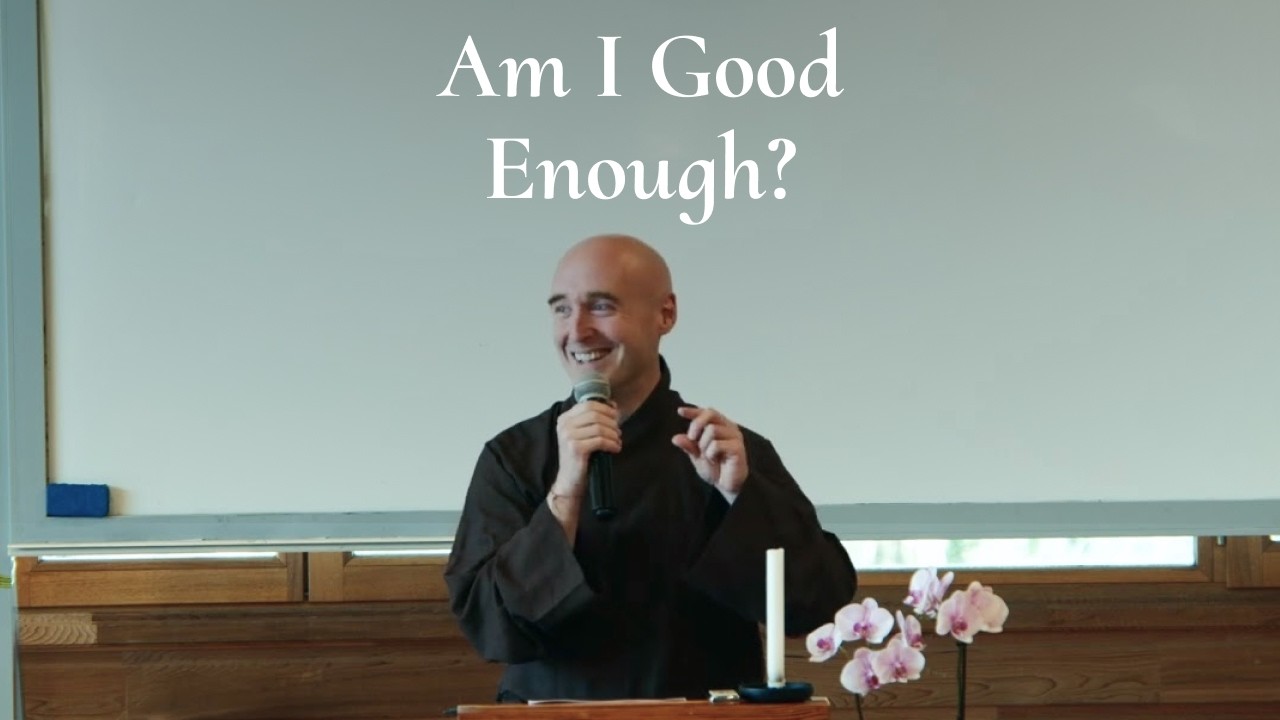
This guided meditation from Sister Don Hanh teaches practitioners to cultivate inner presence through breath awareness while simultaneously recognizing their interconnection with Earth and the air. The 8-minute practice moves through four distinct phases: establishing a comfortable posture, observing natural breath patterns, building body awareness and relaxation, and culminating in a reciprocal recognition that the practitioner is part of Mother Earth while Mother Earth dwells within them. Rather than imposing technique, the meditation invites practitioners to simply notice what is already happening—a foundational approach to mindfulness rooted in the Plum Village tradition.
Why Start With Physical Comfort and Posture?
Sister Don Hanh begins by inviting practitioners to "find a comfortable position" in either a chair or cushion, emphasizing that the body can be "straight but relaxed" (0:15–0:26). This instruction acknowledges a core principle in contemplative practice: the body and mind are not separate. Discomfort or tension in the physical form creates distraction and resistance. By establishing a stable, relaxed posture from the start, practitioners create conditions for the mind to settle naturally rather than spending the meditation negotiating with an aching knee or tight shoulders.
The phrase "let go all the tensions" (0:28) is not a command to force relaxation but an invitation to notice where holding occurs and gently release it. This mirrors a Zen principle: practice works by allowing rather than controlling. The option to close the eyes (0:33) further signals permission—some practitioners benefit from reduced visual input, while others may find it unsettling. Sister Don Hanh trusts the practitioner's own wisdom about what serves them.
What Does the Bell Sound Represent?
The meditation opens and closes with three sounds of the bell (0:37–0:48 and 7:36–7:42). In Zen monasteries, the bell serves multiple functions: it marks transitions, calls practitioners to presence, and symbolizes the interconnection of all beings. Sister Don Hanh recites an invocation with the bell: "I listen. I listen this wonderful sound. Give me back to my true home." This frames the bell not as mere ritual but as a return to one's essential nature—the "true home" being the present moment before thought elaborates upon it.
How Does Breath Observation Build Awareness?
After the opening bell, Sister Don Hanh introduces the core practice: simple breath awareness. Practitioners are invited to notice, "Breathing in, I know that this is an in breath. Breathing out, I know that this is an out breath" (1:32–1:44). This is not visualization or breath control. The teacher explicitly permits natural variation: "If our breath is short, we allow it to be short. If our breath is long, we allow it to be long" (2:20–2:31).
This permissive stance is pedagogically crucial. Many beginners approach meditation expecting to alter their breathing—to make it deeper, slower, or more rhythmic—and then feel they are "failing" when the mind wanders or breath remains shallow. Sister Don Hanh eliminates that trap by making the practice one of observation rather than manipulation. The breath becomes a mirror: noticing what is present teaches the practitioner to be present. This mirrors a teaching common in Zen: enlightenment is not about becoming different but recognizing what already is.
What Is the Role of Body Scanning in This Practice?
Roughly midway through the meditation, Sister Don Hanh introduces a body-awareness phase: "Breathing in, I become aware of my whole body. Breathing out, I smile and relax my whole body" (2:58–3:09). This pairs breath with gentle somatic attention. Rather than tensing and releasing muscles systematically, the practice uses the exhale as an opportunity for the body to release what it has been holding—a natural softening that occurs when tension is not actively maintained.
The instruction to "smile" (3:07) may seem small, but it carries significance in Vietnamese Zen practice. A slight facial smile signals to the nervous system a state of safety and ease, which the body can then internalize. It also serves as a gentle reminder of kindness toward oneself—the practice is not grim endurance but a warm, accepting attention to what is.
How Does the Meditation Connect Personal Breath to Planetary Air?
The meditation's most distinctive turn occurs when Sister Don Hanh shifts from individual body awareness to awareness of Earth and atmosphere. "As I breathe in, I am aware of our beautiful planet Earth, the most beautiful in the entire solar system. As I breathe out, I smile with gratitude to Mother Earth" (4:04–4:40). This is not metaphorical thinking; it is a shift in the scope of attention.
Oxygen that enters the lungs originates in Earth's atmosphere, created and maintained by the biosphere. The air inside the body and the air outside are continuous. By bringing this scientific reality into conscious awareness during meditation, Sister Don Hanh dissolves the illusion of a separate, isolated self. The practice becomes an ecology: "Breathing in, I feel the earth holding me. Breathing out, the air accepts and supports me just as I am" (5:08–5:23).
This recognition is not sentimental. It is precise: the Earth does hold us through gravity; the air does accept and support us through buoyancy and oxygen exchange. The meditation invites the practitioner to feel these facts, not just think them.
What Is the Meaning of "I Am Part of Mother Earth" and "Mother Earth Is Within Me"?
The meditation culminates in a reciprocal affirmation: "As I breathe in, I know that I am part of mother earth. As I breathe out, I see that mother earth is within me" (6:09–6:22). These two statements dissolve the boundary between self and world. The first half—"I am part of Mother Earth"—asserts that the individual is not separate from the planetary system. The second half—"Mother Earth is within me"—completes the circle: the large contains the small, and the small contains the large.
In Buddhist philosophy, this teaching is central to understanding non-self (anatta in Pali). There is no solid, independent self standing apart from the world. Instead, what we call "self" is a process—a temporary organization of matter, energy, and awareness that remains utterly dependent on everything around it. The meditation offers a direct, felt experience of this interdependence rather than an abstract concept.
Where to Go From Here
This guided meditation is a gateway practice. Practitioners who find it resonant may explore deepening through several paths. First, one can return to this same meditation regularly, allowing familiarity and subtlety to emerge over weeks and months. Consistency matters more than duration; five minutes daily outweighs sporadic longer sessions.
Second, practitioners interested in the ecological dimensions of this teaching may explore the full "Zen and the Art of Saving the Planet" (ZASP) course mentioned in the video description. This course situates mindfulness practice within climate awareness and collective action—extending the personal breath-and-Earth connection into questions of how to live in alignment with that recognition.
Third, those drawn to the Zen lineage itself can investigate the Plum Village tradition, founded by Thich Nhat Hanh (Sister Don Hanh's teacher), which emphasizes engaged Buddhism—the integration of meditation practice with compassionate action in the world. The philosophy here is that inner peace and outer justice are not separate pursuits but two expressions of the same awakening.